Spain


This is it. We are just days from the decision on which city will host the 2016 Olympic Games. I know it seems a tad early to be talking about something seven years from now, but you know the host city has years of work ahead of it so the time is now.  After a two-year global campaign featuring four world-class cities, one of the closest bid races in Olympic history will be decided Friday in a vote of the International Olympic Committee in Copenhagen.

The bidding process goes back to May 2007 when cities around the world dropped their hat in the ring for a chance to win the Olympic rings.  Four cities were chosen as the final candidates in June 2008: Tokyo, Rio De Janeiro, Madrid, and Chicago. I have visited three out of four of these cities and can say without hesitation that they are all fabulous. But for some reason I am hoping for Chicago.

At stake is international prestige and exposure, billions of dollars in potential investment and economic spinoffs, and the honor of staging the world’s biggest sports extravaganza.

The decision may come down to two key issues: How much will President Barack Obama’s visit to Copenhagen to pitch Chicago’s case in person affect the outcome?  Is the IOC ready to take a bit of a gamble on Rio and send the Olympics to South America for the very first time?

IOC president Jacques Rogge expects the race for the 2016 Olympics to be decided by “a couple of votes” and says Chicago’s chances shouldn’t hinge on President Obama’s personal visit to push his home city’s bid.  Initially Obama announced he would not be able to attend the vote and that First lady Michelle Obama would go in his place. Now it is reported that he will be there.

“I see really no favorite,” Rogge said last week in a telephone interview with The Associated Press. “I think it’s going to be a very close vote. I think the final vote will be decided by a couple of votes only.”

Tokyo

Tokyo Dome by LL

This amazing city of lights and energy was once considered a possible shoe-in for the games. The country has deep pockets to back the huge financial undertaking of hosting an Olympic Games. Tokyo boasts an amazing infrastructure of public transport and a plan to keep most game facilities within an eight kilometer radius.  But the city’s populous seem to think otherwise. Only 55% of the population supports the games returning to Tokyo (they also hosted in 1964). This is the lowest in that category in which Madrid has the highest percentage with 86% of its citizens supporting the games.

Madrid

Madrid by LL

This is Madrid’s second straight bid. The city finished third behind winner London and Paris in the 2005 vote for the 2012 Olympics. Madrid also was a candidate for the 1972 Games that went to Munich.  The capital city of Spain has about 70 percent of venues completed, a superb transportation system, full financial backing and the overwhelming support of its people – even the King of Spain. Some reports say that Madrid is not the favorite to be chosen for several reasons: partly because Barcelona held the games in 1992, just 20 years ago, while London is to host the 2012 Games and the IOC is unlikely to return to Europe for 2016.

Rio de Janeiro

In this race, Rio – besides its iconic beaches and stunning backdrop – has the strongest emotional pull of the four candidates.  The Olympics have never been held in South America and the time has come to try something new.

“For others it would be just another Olympics, but for Brazil it would be something to raise the self esteem of the people,” Brazilian President Luiz Inacio Lula da Silva said this week. “No other city needs to host an Olympics. Brazil needs it. … Do only rich countries have the right to host the Olympics?”

Rio seemed to pick up the unofficial front-runner’s tag in June when the bid cities made presentations to IOC members in a specially arranged meeting in Lausanne, Switzerland. Rio officials made a splash by unveiling a big world map with dots showing where all the Olympics have been held – and a big empty space for South America.

Chicago

Millennium Park Chicago by LL

My city….and the adopted hometown of the United States President Barack Obama is expected to a front runner along with Rio. Chicago’s so called ‘front lawn,’ a long stretch of parks and lakefront would give the Games a glittering backdrop, like Rio, and plenty of room for playing venues that would not displace millions of people, as they did in Beijing.

Chicago's Lakefront by LL

Despite this week’s announcement that Obama will make a special an appearance in Copenhagen, Olympic officials say they are not worried that his presence may sway the vote.  Maybe another “O” will help. Oprah Winfrey is supposed to be there to support Chicago’s bid as well.  Chicago is bidding to bring the Summer Games back to the U.S. for the first time since Atlanta in 1996. The bid, which would bring the games back to the Olympics’ most lucrative market for sponsorships and television rights, is centered on a compact plan putting most athletes within 15 minutes of their venues along picturesque, ocean-like Lake Michigan.  Chicago overcame one of its biggest hurdles when the city council approved all financial guarantees for the games, clearing the way for Mayor Richard M. Daley to sign the host city contract if Chicago wins. That was a major step for a U.S. bid city, which – unlike rival candidates – can’t rely on federal government financial backing.

There is no way I could just be a tourist in the world for 2 ½ years.  I knew I had to mix it up to prevent boredom and burnout. I craved variety in my everyday life, so why would my life on the road be any different? Yes, of course, the constant change of scenery, culture, and people was variety in and of itself, but I knew I couldn’t just keep showing up in a new town each week and essentially continue to ‘walk around the world for a year.’  I needed to do, ya know, stuff. I needed to immerse myself somehow in society and feel like a part of it.  To start this process, I did different things like a Spanish Immersion program in Costa Rica (Spanish lessons in the morning and yes, surfing lessons in the afternoon) or a two-week, several-hundred mile bicycle trip down the length of Vietnam. But I needed even more structure. I needed…a job (cue shrieking horror music).

Now, just the sheer fact that I decided to blog about my trip and also write travel articles to be published elsewhere means that I was already working. I was trying to make time each week to sit and just write – a very hard thing to do when you are sitting in Rome or Cairo or Hong Kong and there are so many things around you vying for your attention.

Besides my new ‘day job’ as travel writer and photographer, I landed a few other actual jobs around the world.

  1. Barrista and sandwich maker at a café in Melbourne
  2. TV producer and reporter in Chile
  3. Private business English tutor in Istanbul
  4. Media proofreader in Istanbul
  5. Actress in American Feature film in Istanbul
  6. Research Assistant at the University of Cologne helping conduct an International survey on Airline/Airport Relationships
  7. Writer and proofreader at publishing company in Berlin
  8. Publicist for English Immersion company in Madrid
  9. Extra in Hollywood
  10. Pet Sitter around the world (Istanbul, LA, Chicago)

But many have asked me how did I find all these jobs? Did I look before I went on my trip?  The simple answer is no.  I simply arrived in a new place with the random idea that I could maybe find work there. In Australia, I spoke the language (sort of), so it seemed like a natural place to find a job other than teaching English. In Turkey, it’s all about connections and once I met one person…the ball just started rolling.  Besides that, I used persistence, word-of-mouth, and friends’ connections and a lot of smiles.

So, on this adventure, I worked all over and found it to be another great way to “go local.”  I lived in one place for an extended amount of time. I had a place to live. I took public transport (or a bicycle in Melbourne) to work. I had a schedule. I had a paycheck (well, cash). I truly felt like part of the fabric of society. And I actually gained some new skills, but most importantly I made real friends.

To hear more about my working around the world, listen to this podcast interview I did for Chris Christensen at the Amateur Traveler.

Amateur Traveler Episode 194 – Work and Travel Around the World

I spent a few days in the French Countryside with my friend Caroline at her cousin’s house in the tiny, rural town of Bias (pronounced BEE-ah). It was just what I needed – a quiet place to relax, leave my bag on the floor for several days untouched, catch up on some much needed writing, and just hang out by the crackling fire. The house was warm and cozy with terracotta tiled floors and wood beamed ceilings overhead, and the aforementioned big stone fireplace.  We didn’t do a whole lot and I liked it. We cooked a little, sat by the fire, and met some of the sweet French neighbors who had us over for drinks our very first night. We couldn’t really speak much French, they spoke zero English and yet it was a blast.

One day we rode our bikes through the lush and tranquil (except for the random hunter’s gunshots echoing through the air) forest land that surrounds Bias to the beach – normally packed with oiled-up holiday makers in the summer months, now it was quiet and delightful. We had a wonderful lunch in the warm sun of an outdoor café as the waves of the Atlantic crashed up onto the beach down below.

Another day we took a day trip, two hours south to Spain. I love the fact that in Europe, crossing country borders is like crossing state borders in the US; except that here…everything changes-the people, the culture, (formerly the currency), the language. Well, I guess that’s true too if you are crossing into Texas.  It was a lovely day. In San Sebastian, we met up with a friend of mine that I met last year at Pueblo Ingles.  He gave us a great tour of the city – a place that has been compared to Rio since the city comes right down to the beach. It is also known for its amazing food. We went on a mini pintxos (tapas) and beer crawl-going bar to bar trying some of the local treats. Mmm. Good friends and good food – really a perfect day.

A BullringBack home in the States, I’d, of course, heard about bullfighting, but never really realized how big and popular it still is here in modern day Spain. Bullfighting is a traditional spectacle that is still practiced in Spain, Portugal, Southern France, and many Latin American countries. One of the first things I saw in my first city in Spain, Valencia, was the bullring and I have since seen them in basically every city I have visited here. Bullfighting is a centuries-old tradition, but is also a big business. Each year about 24,000 bulls are killed in front of a live audience of more than thirty million people.

As an animal lover, it will not surprise you that I am not thrilled about bull fighting. But, as a journalist I have to tell you that I can’t tell you about it firsthand, because I did not (and could not) go to a fight. Just seeing the postcards on the racks with photos of a bull with banderillas (brightly colored sticks with harpoon points) stuck in his back and blood drenching his fur made me cringe and look away. Now, that being said, I do realize that just because something is different in other countries does not make it wrong. In American thousands of animals suffer every year (especially at our factory farms), and I certainly don’t like this either. But I did learn some more about it…

Not my photo…The fighting bulls are bred specifically for this industry. Supposedly they live a pampered and cushy life before their ‘date with destiny’ in the ring and I’m told that if bullfighting were to become outlawed entirely—there would be no money and therefore no ‘nice’ life for these beasts.

To many, especially in Andalucia, the home of bullfighting, it is a deep cultural ritual—some see it as a form of art—the way ‘man and bull’ perform together. But there is no question to me that the actual fight (no matter how sweet the bull’s life was pre-bull ring) is gruesome and cruel. Often times just before a fight a bull’s horns may be illegal shaved. This affects his balance, but is also a very sensitive and painful thing for the animal. During the fight, men on blindfolded horses drive lances into the bull’s back and neck muscles. The bull’s ability to lift its head is impaired due to severe loss of blood. Then come the banderilleros on foot, who proceed to stab banderillas into the bull’s back to further increase the pain. There are only so many master matadors at the top of their game so also oftentimes it is not a clean kill and the animal is repeatedly stabbed until it’s bloody, painful demise.

There is some opposition to this barbaric sport, but not much here in Spain. Just recently the city of Barcelona outlawed bullfighting, but this maybe more due to the spectacle’s connection to Fascist Spain and former dictator Franco than the bull fighting itself. A 2002 Gallup poll found that nearly 70% of Spaniards express “no interest” in bullfighting while the remaining 30% express “some” or “a lot” of interest. The poll also found significant generational variety, with over 50% of those 65 and older expressing interest, compared with less than a quarter of those 25–34 years of age. Apparently many of the spectators at bullfights are curious tourists who often leave before its over after being overwhelmed by the savage cruelty of it all.

Today’s matadors of Spain are as famous as today’s popstars. One of the most legendary toreros is Manolete, killed by a bull in 1947. Adrien Brody plays him (alongside Penélope Cruz as his lover) in the upcoming movie “Manolete.” Of course, I don’t care really if the matador dies in the ring…because he made the conscious choice to be there. But believe me, no one asked the bull what he wanted.

I celebrated my American Thanksgiving Holiday in Sevilla, Spain. I was lucky enough to be invited by a friend (an Australian friend, no less), Kristy, to the traditional American feast at where else? An Irish Pub, of course. I have found that these are the unofficial meeting spots of expats all over the world. And there seems to be an Irish Pub in just about every city and small town I have visited. Since moving toHappy Pavo Day! Sevilla to be with her Spanish boyfriend, Kristy has fallen into a group of American girls who also live there. They call themselves “the Americanitas, and one odd Aussie.” Catchy, isn’t it?

There were about twelve of us on a back heated patio of the Irish bar that was advertising a special scrumptious ‘Thanksgiving’ feast for 20 Euros—not very cheap for what they gave us, but it was worth it to me to be meeting new people and spending the holiday laughing and socializing.

Okay, I’ll admit the food they served looked more like airplane food or the ‘fine cuisine’ we got back in the day under the fluorescent lights of the high schoolAn Irish-American Holiday Feast! cafeteria. The stuffing and mashed potatoes looked dry and were perfectly round ball shapes probably As American as Apple Pie!scooped out of some huge prison-like cooking vessel with an ice cream scooper. But looks can be deceiving, because it actually tasted quite good. And, believe me, it wasn’t because I was missing ‘American food.’ In fact, that brings me to my next point actually. What really is American food? Recently, a Spanish friend asked me to make him some traditional American dishes. He wanted to know, ‘what is American food?’ It took me mere seconds to answer, ‘Mexican, Chinese, Sushi, Indian, Thai, Italian (really what is more American—than pizza?!), Greek, Middle Eastern, Ethiopian, Polish, on and on.’

He was like ‘No, I mean real American food?’

Unfortunately, around the world, for those who haven’t stepped onto our fair shores, many assume we are all chowingThai Fry Guy down at the ‘Golden Arches’ (McDs) or KFC and eating hamburgers and hot dogs ‘til we explode. Now, The Colonel in Dubaifor some, I guess there is some truth to this. But, I would say, living in Chicago, I have food from all over the world right out my front door. I guess it’s just like the stereotypes Americans have about some foreign cultures. Well, don’t feel bad ‘my fellow Americans’ because there are many, many negative stereotypes floating around the world about America and Americans especially amongst people who have never traveled to the US, but feel they have because they have seen “Cops” reruns or movies like “Dumb and Dumber” and “Hey Dude, Where’s My Car?” (cinematic excellence I’m sure…but this American hasn’t seen either of these Oscar-worthy films).

“Okay, fine, but what did you eat growing up?”

Well, that was easy—like most people coming from the Northeast—Pizza and Chinese food.

Still not sounding very ‘American’ to him he replied, “Okay, but what foods did your parents or grandparents cook at home?”

Not the singer…Okay. Okay. We had our fair share of meatloaf, chicken with rice, and the occasional spaghetti withThe Chef? meatballs (still sort of Italian I guess—although, I’m sure the Italians would scoff at this 1970s American dish or some horribly lame can of ‘Chef Boyardee,’ a chemical-laden packet of ‘Hamburger Helper,’ or my personal childhood fav: a tasty, comforting box of completely processed, bright yellow Kraft Macaroni and Cheese.) Mmmmmm-mmmm. My mom would always add some onions and an extra slice of plastic-wrapped Comfort Food at its finestcanary yellow Kraft ‘cheese-food’ for that just-right, gourmet touch. But for many, actually, having their grandma’s cooking, was even more ethnic since the grandparents were often literally just ‘off the boat,’ from some far off land. So what is my point? What is American cooking? I guess I can consult the master chef’s in America: Chicago’s Charlie Trotter and Grant Achatz, NYC’s Mario Batale (before his Food Network fame) and Alfred Portale (Gotham Bar & Grill), and Thomas Keller of the French Laundry who all use a lot of seasonal locally grown and farmed ingredients in their internationally influenced masterpiece fish, meat, and poultry dishes. But I think it is indisputable that American cooking has been influenced by the millions and millions of immigrants that started it all and that now call America home. Buen Provecho!

I spent the last few weeks making my way down around Southern Spain into the Andalucía region—an area that is “Spain” intensified and is said to be the most ‘undiluted’ heart of the country. It is also the original home of tapas, brutal bull fighting, and passionate flamenco dancing. I started in charming Granada which is home to the magical and awe-inspiring former Muslim Palace of Alhambra. I spent a few lazy days soaking up the Mediterranean rays in the ‘tranquilo’ tiny white-washed Costa del Sol town of Nerja. And then spent a few more ‘days doing nothing’ in Cadiz just west of the ‘rock of Gibraltar’ and on the beaches of the Atlantic Ocean. I can’t believe I’ve already reached the shores of the Atlantic. I gazed across toward America blew a kiss and continued to…do nothing. So, keeping with this relaxed theme…I therefore did not write anything (well except this paragraph). So instead, you can also relax and ‘just look at the pictures.’

PS-I’m heading to London for Christmas and New Years. Does anyone know ANYONE I can meet there? Thanks.

Where am I?

Flowers in Alhambra

Sunset over Alhambra

run!Sunset in Nerja

Albaycin Quarter

Flowers in Nerja

Nerja Nights

Beach Days in November

Hidden Coves

Cadiz Beach Cadiz Days…

So, I was really loving this whole ‘couch surfing’ experience. After I returned to Madrid after my week at “English Camp” I ended up staying at my new friend Alex’s place for a few days. He lived about thirty minutes out of downtown Madrid at the last metro stop. It was in a quieter residential neighborhood pretty far from the hustle of downtown and a bit ‘out of the way’, but it was great. I had my own room and I ended up even having the whole place to myself because Alex went away for the weekend with some friends and he trusted me and just left me the keys. Well, I thought he left me the keys. He left me a spare set that we tested on all doors to his apartment–there is the exterior building door, an interior common door and then finally his apartment door. The problem was the outside door key was not a good copy and therefore it was hard to open. So, being the gentleman he is, Alex switched the key with his master key so I wouldn’t have any problems—or so we thought.

The next day I spent out walking around Madrid didn’t return until about 11pm. This is when I realized, much to my dismay, that now I had two keys for the outside building door and NO key for his apartment door. You see, these keys look very similar…so similar in fact, that when Alex switched the keys (which was supposed to make my life easier) he accidentally gave me two of the same key. So now he had the same two keys for his apartment door and I had the same two keys for the external building door. After trying, in vain, to jam the key in his lock (isn’t it usually the guy trying to do this??), I tried to stay calm and figure out my options. My first option was to just try the key again one more time—maybe somehow I was simply a moron and forgot how to work a key? Nope. It was the wrong key. In this situation, I would have loved to be the moron. Alex was three hours south of here partying with his friends for Halloween. BUT, his parents lived a ten minute walk away…and luckily he had shown me their apartment just two days earlier. They must have a spare key. Did I pay attention when we went there—of course not—Alex was with me. But somehow I had to remember where it was and I knew their last name so hopefully I could ring their apartment and in my best Spanish explain to them through the intercom that I was not a mass murderer or vagabond looking for food…just ‘una amiga de sus hijo.’

So I set out toward their place. All the way there, I was trying to calm myself down and telling myself not to worry because they would be there, just sitting there missing their son and holding tightly onto his spare keys. I also practiced over and over how to explain my predicament in Spanish—I wasn’t too up on the ‘locked out’ vocabulary. But when I got to what I thought was their building, I discovered there were about four different entrances AND the buzzer only had apartment numbers–no names. I was doomed. Okay, stay calm Lisa. Don’t freak out yet. I was starting to panic. I looked through the glass doors to the mailboxes and could make out some last names, but only the people that wrote with markers…the rest were too far and too hard to see. And, yes, of course, there were several Rodriguezes. This is not good. I can’t ring all these people who probably speak no English. Okay, don’t panic. I knew they lived on a higher floor because when we were there, we had ridden the elevator. But that’s all I could remember. I decided to go around the building to two other entrances. We had driven out of their garage on this side entrance, but I could not remember for the life of me if the actual front door was over there. Then miraculously, somehow, while walking up the set of steps to the last entrance I recognized a big crack in the marble. I have no idea how this ‘fissure of hope’ registered in my brain the first time we were here, but it was like a long lost friend. I just somehow remembered looking down at it when we first were here and wondering if the step would be loose. Since I hurt my ankle the first time (remember from the running story??) I have been extra careful to watch my step everywhere. So, I knew this must be their entrance. Finally, there it was–a mailbox with their name and even Alejandro’s name on it. Okay, things are looking up. I practiced the Spanish phrases I would say to explain my sad case. I rang their buzzer. Then I rang it again. And again. Okay, things are looking down now. They are not home. And, probably like the rest of Spain, are away for the holiday weekend. Shit. I don’t have Alex’s number with me (yes, I left it inside his apartment that I was locked out of). And I don’t have a phone to call him on anyway. I don’t have anything except my purse and a gossip magazine I bought at a newsstand…I guess I can sit on the magazine or if it starts raining I can use it as a hat. His parents were the only link I had. Okay, ‘maybe they will be home soon’, I tried to tell myself. ‘After all, it’s only after 11pm and Spaniards stay out late.’ My head started to spin, thinking about where I would sleep. Should I just sit on the steps here? What the hell am I going to do?

I’m all alone in Madrid with no friends, no phone, and all my things are locked inside an apartment and the owner will not be home for four days. Basically, I would have to find a computer somewhere (I would have to ride the train back downtown…and find some late night internet café) where I could look up Alex’s phone number…then call him and hope he has a cell signal wherever he is and hope his phone is even turned on. But then what if he says that his parents have no key to his place…then would he have to cancel his trip and come here—or I’d have to get a hotel for 4 days with no belongings—just the clothes on my back. Now I was starting to get nauseous.

Suddenly, a family of three walked up the steps.

“Hola. Habla Ingles?” I asked desperately.
“Yes, I do,” replied the husband, my savior.


I asked him if he knew the Rodriguezs and, surely by some stroke of coincidental luck or perhaps divine intervention, not only did he know them, he was their next door neighbor. Oh, thank God. And he even had Alex’s cell number on his phone. My luck was changing. He called but got no answer. He then called Alex’s sister. Oh, yes, good idea! Maybe she has a key! It turns out that she was at a bar just a ten minute drive away. So, this amazing prince, Antonio, drove me over to find her. On the way there, we chatted and I thanked him profusely for his kindness. He asked what I was doing in Madrid and I mentioned wanting to find work here possibly teaching English. Well, turns out he wants a private tutor for his son. So now I have no keys, but maybe have found some work in a very convoluted job search method! He dropped me off at the bar and I met Alex’s sister, Esther (who speaks no English), her boyfriend, and their friends. She had already spoken to Alex on the phone and we all headed back over to his apartment because I thought she said a neighbor had a key. I tried to explain that I had two of the same key, but my Spanish vocabulary about keys and locks was strangely still not up to snuff. So, Alex thought I was just some silly girl who could not figure out the lock. So, we went back in vain, and tried the damn key again even though I knew it would not work. If it did—then I truly was a moron. But, we all tried it again and I tried to show them both keys and how they were identical. Finally, they understood the problem and gave me the bad news…that no one had any spares at all. Great.


She called Alex back on his cell phone and now, finally, everyone was on the same page. I was locked out. I had two keys for the OUTSIDE door and none for the INSIDE door. Oh…now we get it. But, then Alex told her that we could break into oneBreaking and Entering? of the doors. Alright, I like this plan. So now, Esther had to ring a random neighbor to let us into his apartment and then into an inner courtyard that was only accessible from each apartment. She broke into Alex’s apartment and lo and behold let us all in the front door. Home at last, thank god almighty, home at last (thanks MLK). I was reunited with my belongings and a place to sleep. Hallelujah. Now, we just had to figure out how I can stay here for the next few days with no key to the front door. I had a key to the upper lock, just not the lower…so everyone agreed with my plan to tape the door latch open on the bottom (so it would not lock when closed) and then I could just lock and unlock the top lock.

My nightmare evening actually turned into a fun adventure with new friends and I truly could not believe at first how unlucky I felt and then how incredibly lucky I felt, within an hour’s time, to have found their neighbor Antonio who then found Alex’s sister…who then was able to get me in. It almost seems too random to be true. But it happened. And me and my stuff are reunited (and it feels so good) and here to tell you so. And, believe me, the next day, I was scared to leave, but before I left, I tried my keys in every lock—twice—just to make sure I could get back in.

During my travels, as I’ve mentioned before, the best, most important part has been meeting new people—locals and other travelers and learning a lot about the world from other’s perspectives and this ‘community’ of nomads we are all a part of. I’ve recently discovered a great hospitality website called couchsurfing.com. Actually I probably read about it a year ago, but had been hesitant to really do it and now I wish I had sooner. It is basically a ‘community’ of like-minded travelers and other folks interested in meeting and exchanging ideas with people from all over the world. Basically you can sign up (for free) as a traveler like I did, or as a host–someone with a couch (or bed) that someone visiting your hometown can crash on. Each person has a profile and is reviewed by other users so you know you will be meeting someone you can trust and that has some things in common. Membership is free and is obtained simply by registering on the website. As a surfer (guest), you can search for and request accommodation at your destination. Accommodation is entirely consensual between the host and surfer, and the duration, nature, and terms of the surfer’s stay are generally worked out in advance to the convenience of both parties. It is SO global–there are ‘surfers’ in nearly every country around the world—you can find a couch to stay on in places like Iran or Antarctica or Fiji or Pittsburgh. Every time I go on the website, I find myself getting sucked in to wanting to go to other places I haven’t been yet—and this makes it SO easy and SO affordable. And not only can you search for hosts in a certain city, you can also ‘see’ what other travelers are near you and meet them if you want. If you haven’t heard of it yet, you will start to hear a lot more about it now, I promise. There are already a few documentaries in the works on couch surfing and some are surfing around the world and writing about it. I had to include this link from a guy surfing the world who stopped in Chicago and loved it—of course he would! Too bad I didn’t think of that first. You can read the NY Times Article here.

Hospitality networks — communities set up to enable travelers to share the home of a foreign host — are nothing new. Launched in 1949, the United Nations-recognized Servas had the lofty aim of realizing Gandhi’s maxim: “The best way to find yourself is to lose yourself in the service of others.” But Servas requires a lengthy registration process, membership fee and minimum four-week notice period of a home stay. I looked into it (after a big recommendation from my new Aussie Pals Mark and Jan), but this was something I was just not able to really do since I was already on the road.

Later, networks like the Hospitality Club, which now has 250,000 members in 207 countries, found a happy home on the web. This site and others were largely used by backpackers and gap-year travelers, who were attracted by the dual benefits of saving precious cash and “living like the locals”.

But it was in 2004, with the launch of The CouchSurfing Project, that a new verb was coined and a real mainstream travel trend born. Couchsurfing.com was the brainchild of Casey Fenton, an American web consultant who, after buying a bargain flight to Iceland, realized that he had no interest in spending his hard-earned greenbacks on “rotting in a hotel all weekend playing Mr. Tourist”. A child of the internet age, Fenton came up with the idea of using the random networking potential of the web to spam a couple of thousand Reykjavik students, asking whether they’d put him up on their sofas and show him around their home city. The same year, he launched the CouchSurfing Project. The website broadened its focus to online chat and a shared passion for travel, and with several thousand recruits joining the project’s 350,000 registered users each week, Couchsurfing.com is now an undisputed phenomenon.

Some more fun statistics right off their website:

  • CouchSurfers…..352,942
  • Successful Surf or Host Experiences…..262,528
  • Friendships Created…..317,932
  • Positive Experiences…..474,689
  • Countries Represented…..223
  • Cities Represented…..32,972

I actually just started using it in Spain and it’s really quite amazing. In Valencia, I met Clara, originally from Argentina, forPreheat…rinse…repeat dinner. (You can also just meet someone local for a drink or dinner—it’s not always necessarily to stay at their house or apartment). Then when I got to Madrid, another couchsurfer, Alex, invited me to join him at a Spanish cooking class he organized for foreign students who are studying in Spain. The class was naturally in Spanish and we learned how to make tortilla Espanola (Spanish omelet), a type of paella, and some dessert.

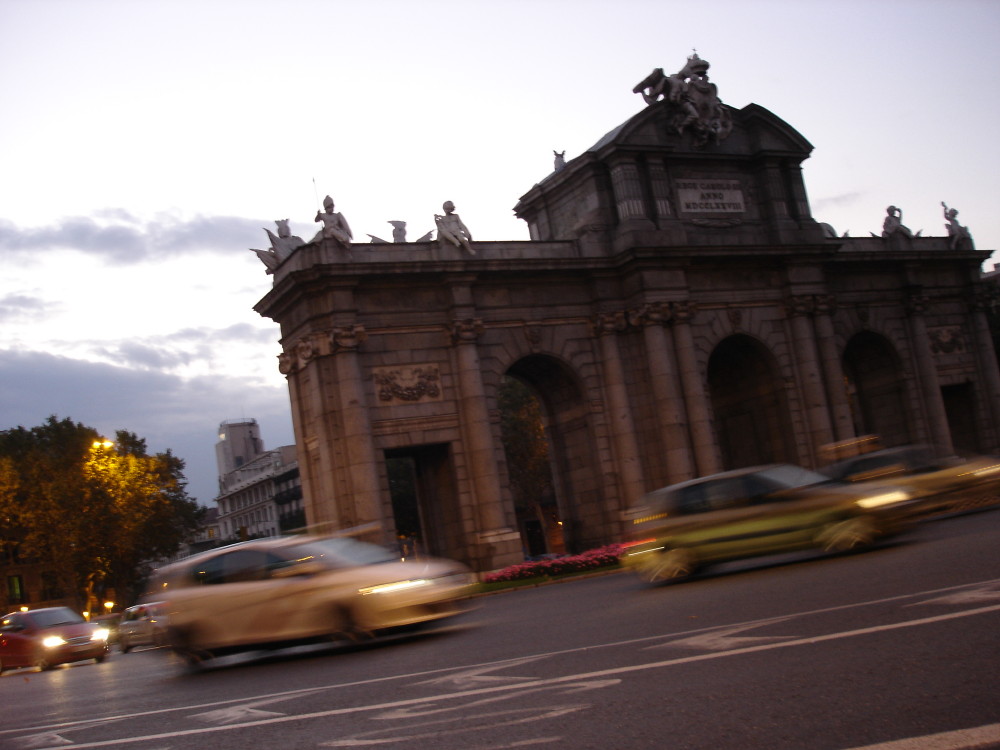
Puerta AlcalaAfter showing me around Madrid a bit—from the beautiful squares to the very green Retiro Park (where at least 3 dealers offered us marijuana as we strolled through the park), Alex took me on sort of aRetiro Retreat tapas crawl where we ate and drank at a bunch of his favorite bars around the city. He even got me to try orejas (pig ears) which I have to say were crunchy, ‘bacony,’ and besides being super greasy, were quite tasty. We ended up Alex a Los Gatosdrinking free beers at nightclubs that were trying to lure people in to fill up their dance floor. It was so fun to be with a local who already felt like a friend. Alex is a sweet guy who has already hosted dozens of folks at his home. He even keeps a guest book to prove it! He runs quite the little hotel right in his own apartment.I “surfed” here

I ended up crashing at Alex’s place a week later and it honestly felt like I was staying at a friend’s house…not a stranger. I had my own room—so technically I wasn’t even ‘couch’ surfing—I had my very own bed. It seems that if you are part of couch surfing—you are happy to host people and make them feel at home…and this is exactly what Alex did.

Next I met Nathalie, a cute French gal who’s been living in Madrid with her husband. She invited me to a ‘couch surfing’ picnic at Retiro Park where I met even more CSers. It’s a never ending chain of new friends (and on the site there is even a “six degrees” chain showing you how each person knows someone else you ‘surfed’ with) and something I can’t get enoughPiotr & Friends… of now that I’ve gotten into it.

The Way to Nerja…I’ve also just met, Piotr, a Swede living on the Mediterranean in southern Spain. I hung out with him and his friends for three days in Nerja. He, like me, gave up everything and moved here to simply ‘hang out’ and enjoy life for awhile. Sweet.

On my whole trip—I’m constantly meeting new people and haveSunshine in Paradise… mentioned before how I rarely feel alone, but of course there are places I’ve been to where I just didn’t really get to know anyone. Well, now, thanks to Couch Surfing…there is really no city I can go to and not have instant ‘friends.’ It’s really an amazing thing and for solo travelers like me…it really truly means that I will never have to be alone if I don’t want to be. It’s always the goal of a good traveler to meet the locals and really see what ‘real life’ is like for them. There is no better way to do this than by staying in their homes. And this is something that sometimes was hard to achieve—not anymore. Now, locals (from Namibia to Venezuela and the Ukraine to Uzbekistan) are just a click away—waiting to meet you. I think their motto says it all: “Participate in Creating a Better World, One Couch at a Time.”

Here are some great testimonials from the site:

“I have met and stayed with some incredible people through CouchSurfing.com These are warm, friendly local people who a regular tourist would never meet, and their travel experience would be far richer if they had. Besides the obvious benefit of not having to pay for accommodation, CouchSurfing allows travellers to experience a country and its culture from within, instead of just as an observer. Inevitably, a CouchSurfing host will introduce you to his or her friends, and take you to the places that they enjoy. Basically, you can become part of their life for the time you’re visiting. I promise your life will be richer through your membership to CouchSurfing.”

“CouchSurfing has changed my life even though I have only known it for 4 months! The connections I have made, with some of the greatest people I have ever been able to encounter, along with the sense of being connected to the entire world just excites me. I feel like I am making a difference in the world supporting this site/community and informing others like me about the greatness that is occurring! I cannot wait to meet more of you beautiful people. Cause we don’t know each other, but we love each other.”

“… when you sign up you make thousands of friends you never knew you had and all there is left to do is go meet them.”

What if I told you that I just had a whole week’s vacation in four-star hotel villa in a small rustic beautiful village near Salamanca, Spain with three full meals a day and wine and it came with about forty new friends …all for free? Well, I did. And, I know what you’re thinking—‘what’s the catch?’ Well, there was one–all I had to do was speak English. And considering it is my native language…how hard could that be?

Pueblo Inglés is not exactly a school for English—it’s more like an intense English ‘experience.’ It’s a unique opportunity for native English speakers to immerse themselves in Spain’s culture and people firsthand in exchange for just chatting in English with Spaniards. And for the Spanish people, it’s like an intensive week-long camp or retreat entirely in English which gives them the opportunity to improve and practice their English the best way—by force of course. They are forbidden to speak in their native tongue all week and must converse in and listen to English at all hours of the day. Easy for me, not so much for them.

I was trawling the web one day looking for a job in Spain when the website for Pueblo Inglés popped up. The idea scared and intrigued me at the same time—not only would I be able to travel one more week without spending a dime (that’s 15 cents in Euro!), it would enable me to meet and connect with real Spaniards who mostly come from the professional business world (I found out later how ‘professional’ they really were)—something I find hard to do since the majority of locals I meet in many countries are folks who work in the tourism or service industries. It was another way for me to ‘break away’ from just being a tourist…as I’ve tried to do during my travels by working, volunteering, or just staying with friends and ‘hanging out’ instead of feeling pressure to sightsee and visit every old church in every old town I’m in. I applied on a whim not knowing if I truly wanted to commit to this week of constant jibber-jabbing, but, figured they probably wouldn’t accept me on such short notice or I could always say ‘no.’ Just one day later I received an email informing me that I had been accepted into the program and it was starting in two days! Okay…well…I guess I’m doing it! As I was still in Valencia, I had to quickly make some arrangements for transport and book a hotel in Madrid. And the very next day I high-tailed it to the capital city for the orientation.

Gorgeous PlaceThe first day of the eight-day program we all gathered in a plaza in Madrid and were herded onto a bus.Peaceful We rode for three hours west of Madrid to a tiny rural town called La Alberca full of winding cobblestone lanes and green hills dotted with clusters of trees all in their autumn best dropping acorns and chestnuts all over the countryside. Our hotel was in a bucolic setting with shady paths and ponds and was more like a group of several chalets. There were about 20 English speakers from Canada, the US, England, Australia, and Ireland and 20 Spaniards from all over Spain with ages ranging from early twenties to sixty plus.

Our program directors, Pablo and Akemi, laid down the law at the get-go: The most important rule of Pueblo Inglés–NO Spanish allowed. They really wanted this to be a true and hardcore immersion experience for the Spaniards—basically forcing them to drink, eat, sleep, and possibly dream in English.

Thanks Brian!!Each morning after a buffet breakfast we paired off into ‘couples’ for ‘one to one’ conversations that would last about 50 minutes. After a ten minute break, we would then swap and grab another Spaniard for the next hour and so on. Everyone was unique and friendly and fun and never once did we run out of things to talk about. But, it was an odd and funny sight toWe are Cold! see all these coupled pairs of people wandering around the grounds, sitting in chairs, and strolling down the street. If someone didn’t know better, it probably looked like some kind of psychiatric institution or rehab center where we were all getting over our drug, alcohol, or other addictions. Of course, if they saw our parties every night, they would probably think it wasn’t a very good program. Every time I walked The Dating Game!around it made me laugh to see everyone chatting and ‘recovering.’ We would usually have a break sometime in the morning and also other activities like games, conference calls, and presentations—where lucky Spaniards got to tell us all about their jobs or Anglos entertained us with some kind of unique skill they have (singing, dancing, and other random embarrassing behavior). A three-course lunch with plenty of vino (nothing gets conversations going like some cheap wine can) was at two o’clock, followed by the very crucial Spanish siesta (nap time) until five o’clock. Then we continued with more talking, group discussions about anything and everything and hilarious skits. The skits and presentations were my favorite part. It reminded me of some university days doing role playing and brainstorming to come up with the most entertaining performance.

Jesus & Potola do the SevillanasIt was fun to just be silly and what I really remember most is laughing almost all the time…something I“Play that funky music white boy!” strive to do anyway and it was quite easy to do here. A three-course dinner with more wine, of course, was at nine (a little late for the Anglos, too early for the Spaniards!)…and then their Inglés would really get tested as many of us hung out at the bar until the wee hours of the morning. Not only was it great getting to know the Spanish folks, it was even more fun dancing with them. We did some salsa, we learned (not really) the Sevillanas (a traditional dance from the Andalucía region of Spain), had a girls vs. guys dance-fever style ‘dance-off’ (the chicas were robbed!), we even ‘Macarana-ed’ and did the ‘Electric Slide’—scary, but fun.

The #1 Witch!One night we were treated to the Spanish tradition of the Queimada. Queimada is said to originate fromLas Chicas! Pagan festivals of Galicia, the northwest region of Spain. It is a punch made from Orujo – a Spanish liquor containing 50% alcohol and flavored with coffee beans, plus sugar, lemon peel and cinnamon. Traditionally while preparing the punch, it is set on fire (thanks to the large amounts of alcohol) and a ‘witches’ spell is recited, so that special powers are conferred to the queimada and those drinking it.[youtube=http://youtube.com/watch?v=Jf-CVDUtiL8]

Jesus y Yo!Maybe the queimada gave us special powers to not need sleep because, needless to say, some of usBar Dancers?! danced and partied nearly every single night ‘til 4 or 5 in the morning. Some nights, Peter, the guy who worked the hotel bar (and served the food, and drove the van, and maybe cut the grass…) actually wanted to go to sleep so he would close the hotel bar and a bunch of us who still had the energy (mostly Spaniards) would go to ‘David’s Private After-Party’ in his cottage. Staying up this late, this frequently, is something I rarely am able do anymore—especially back home when I’m working. I particularly noticed how amazing it is to feel this free and not have to worry about really anything. Even back in my university days I always had some worries in the back of my mind about exams, papers, boyfriends, etc. But here, my whole schedule was laid out for me. I had my ownChillin’ at the after party… small ‘villa’ Salud!that I shared with Potola a sweet and hilarious flight attendant who can dance a mean Sevillanas. Our ‘casa’ was just steps from the lobby and bar so it was so easy to stumble to bed before sunrise, and get up the next morning (even if it was only a few hours later) and just walk over to my next session of speaking English. There was no commute, no metro, no taxi. You just walked home in two minutes. Life was good. Really all you had to remember to do was brush your teeth and shower. And speak English, of course.

It was easy for me, but much harder and more tiring for the Spaniards who had to do everything in their second language. Imagine being constantly forced to speak Spanish all day. Your brain would be so tired. And evenSalsa Time! when they were ‘enjoying the fruits of the vine” (okay, drunk) and dancing they were still speaking English. They even got a kick out of telling dirty jokes in English …although, some, I’m sure were much funnier in Spanish as the translations didn’t do them justice. But, still I was very impressed.

Mid-week we took a break and got a tour of the town that even included, of course, some tasty local wine, Marc does the Bota!ham, and cheese. Oh, and then there was the Bota (a ‘bag’ of wine typically made from goat skin) drinking contest. And, yes, this was the day right after our latest party. I was already running on basically two hours of sleep, was hung-over, and not sure how these guys could manage this—but they basically squirted as much wine as they could into their gullets while everyone counted along. The winner drank for something like 70 counts. Okay, I was already hiding around the corner with a couple other ‘girls’. I just couldn’t do it.

Like with other tours and classes I’ve done around the world—there was an interesting variety of people to get to know andMe & Los Chicos of course, a few characters. With such an intense environment of talking, we quickly got to know each other and all became friends. They were a fun, great group of people that I willMe & Big Papa! never forget: from Jesus, a true professional, and one of the funniest guys there to Antonio—the ringer. He was an older, big family guy and at first glance you didn’t expect him to be funny, but this man was hilarious. He was in several groups I was in and was always coming up with witty ideas of how to make things funnier. And not only were we learning English–we also learned some Basque, some Catalonian, a bit of Gaelic, and even sign language, and, of course, how to do an Eskimo dance.

The PI GangAfter a week of fun…we all ‘graduated’ and received our certificates for completing not only a week long English ‘course’ but one of the most fun weeks I’ve had in a long time. All in all, theJacinto Y LL week spent at Pueblo Inglés was like an intense microcosm of life—a condensed, easy version of life and having to say goodbye after our amazing week together was hard for me. Hopefully the Spaniards improved their English (they can definitely order more drinks and tell jokes in English now—usually good for the business world, right?) and I know I have made some amazing new friends here in Spain that will remain in my heart and I hope in my life always.Gooooooooal!!!!!!

(sorry, here are some inside jokes):

Psssssssh! Pssssshhhh!
Under the weather??
Enjoy It!
Ball that’s Yellow (Yellow ball!)
Leave your hat on—Jesus, David, Luis, Vicente, Brian, Jose Angel & Alberto Garcia!the boys can dance!
One to Ones

Incredible Professional!
Now THIS is the most wonderful moment!
Groovin’ to Sergio’s mobile: ‘it’s your birthday…’
Lies and truths
Everyone: Alive, alive oh!, alive, alive oh! Crying cockles and mussels alive, alive oh!
Say: All those who are wearing…Little Red Riding Enric

Here is a video on the program done by a BBC Morning Program:

One of the things that always makes me feel like a real local…is going for a run. Jogging along with other native folks, sweating just the same, definitely has a non-tourist feel to it. Of course, don’t get the wrong impression—that I’m some kind of perfect die-hard runner—nothing could be further from the truth. I have only gone running a handful of times during my whole entire trip. That’s pretty pathetic when I think about how I would run or go to the gym back home at least three times a week (okay, on good weeks). But, hey, I did cycle nearly the entire length of Vietnam and the amount of walking and hiking I’m doing is incomparable to my old daily life of sitting behind my computer cooped up in the caverns of a TV station studio or editing room all day long. Not to make excuses, but I did have an unfortunate ankle-twisting situation months ago back in Melbourne, Australia after one too many glasses of wine and some steep stairs to the bathroom. This put me off of running for awhile especially since my ankle looked like a mango for a few months.

So, now that I got a brand spankin’ new ipod for my birthday (thanks mom!) and my ankle has had six months to heal—I figured I’d run (no pun intended) out of excuses. Plus, thankfully Claudia dragged me out to run in Cologne and I couldn’t believe we ran about 6 or 7 kilometers…something I rarely do.

Grand PlazasSo here I was jogging along the palm-tree lined streets of Valencia, Spain. It was beautiful. It was warm.The Post Office And the centuries-old architecture was distracting me from the fact that I hate running. And then, I saved a life. Oh yes, you heard me. On a busy boulevard I noticed a car was stopped in the middle of the street beeping its horn. I thought they were saying ‘hola’ to an older woman who was standing in the grassy median while her dog did his ‘business.’ Then the dog-woman started flailing her arms wildly and I got curious. I stepped off the sidewalk to have a look past the parked cars that were blocking my view. There, in front of the car, was a tiny grey kitty, stopped dead in his tracks full of fear. An animal in distress always sends me running (no pun intended)…so I jumped out into traffic (it was me or the cat) and shooed the little guy to the safety of the sidewalk. He darted under the parked cars and the four of us (the dog walker, the car passengers, myself, and, of course, Señor gato) let out a sigh or relief, exchanged waves and smiles and went on our way. No one spoke a word, but it was nice to see we were all on the side of the cat. And, in some odd way, I felt like a member of their society and not just a jogging tourist.

Next Page »